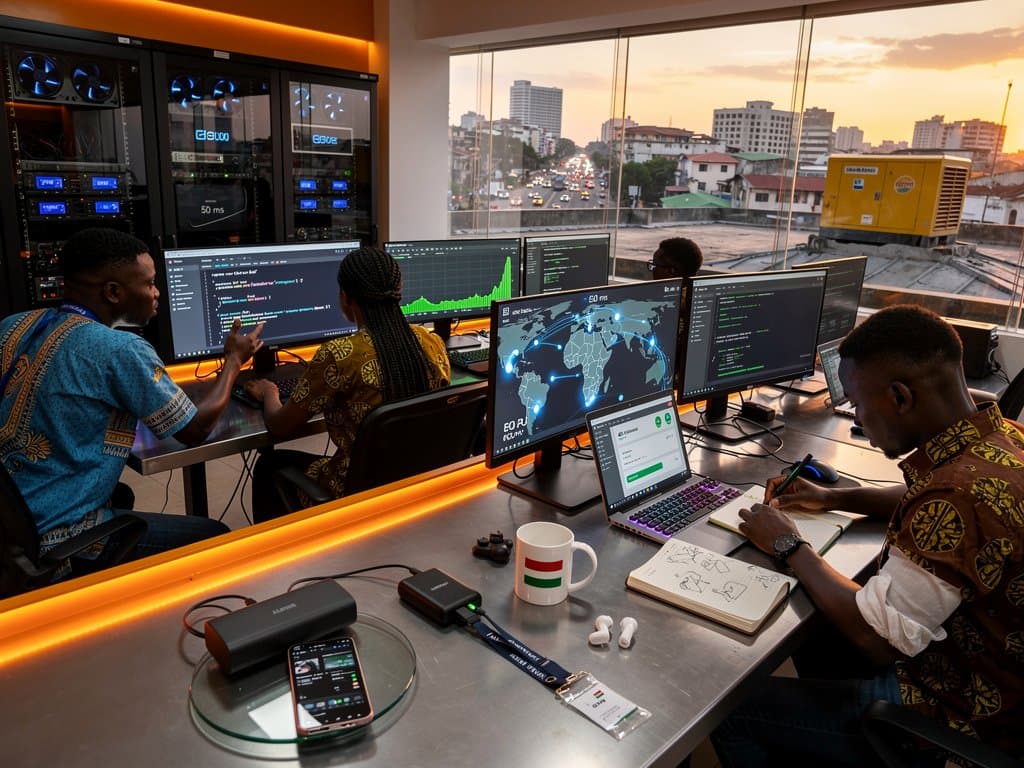
- 1. Cloudflare AI platform accesses 70+ models across 12+ providers via one API.
- 2. AI agents chain up to 10 calls; slow providers add 500ms total latency.
- 3. Edge networks in Lagos cut inference to sub-100ms for Nigerian fintech.
Cloudflare AI platform launched on April 17, 2024, per the company's official blog. It delivers over 70 models from 12 providers through one unified API. Workers AI and AI Gateway enable low-latency inference. Lagos developers at CcHUB build AI agents without vendor lock-in.
Nigerian fintech firms chain up to 10 inference calls per task. A single slow provider adds 50ms per call. This totals 500ms, according to Cloudflare's blog post by CEO Matthew Prince. AI Gateway dynamically routes to fastest options.
Low-Latency Inference Tackles Nigeria's Infrastructure Gaps
OpenAI and Anthropic models integrate seamlessly via AI Gateway with Workers AI. This supports NITDA-compliant agritech and fintech apps in Nigeria.
Workers AI runs models serverlessly using ai.run() in Cloudflare Workers. Developers deploy via cog.yaml with Python 3.13. Scale factors reach up to 1.5x.
Cloudflare's blog details the platform mechanics (April 17, 2024). Edge points-of-presence in Lagos and Johannesburg achieve sub-100ms latency. This holds despite MTN and Airtel network variability, per Nigerian Communications Commission (NCC) Q4 2023 data.
Andela engineers in Yaba prototype payment verification agents without latency spikes.
Edge Networks Boost Nigerian and Pan-African Devs
US-based providers deliver over 300ms latency to Abuja developers. Cloudflare's 310+ global cities reduce this for local fintech like Flutterwave.
Ten inference calls at 50ms each total under 500ms. This beats 2-second delays from distant servers. NITDA's 2023 digital economy report praises such tools for financial inclusion.
Workers AI documentation outlines deployment. Access Claude 3 Opus via Gateway without multiple APIs. This simplifies ops at AltSchool Africa.
Kenya's M-Pesa uses similar low-latency edge AI via Safaricom. Nigeria's 9mobile could match with Cloudflare. Yaba hubs now compete continent-wide.
UNILAG AI pipelines tap free tiers amid ASUU disruptions.
Nigeria's Broadband and Power Shape AI Adoption
Nigeria's fixed broadband penetration hit 45.6% in 2023, per NCC Q4 quarterly report. Power outages force generator reliance in co-working spaces like Ventures Platform.
Edge inference offloads heavy compute from unreliable grids. Agritech agents in northern Nigeria chain satellite imagery analysis without timeouts.
AI Gateway docs explain routing logic. This uses speed- and cost-based routing. It levels the field against Silicon Valley for pan-African startups.
Python handlers scale predictions dynamically. EdTech tutors emerge despite strikes.
Fintech Gains Under CBN Regulations
CBN's open banking framework demands AI for KYC chains. These run from facial recognition to risk scoring.
Blend OpenAI chat with Anthropic reasoning across 70+ models. This mirrors NIBSS instant payments infrastructure.
Agentic AI evolves quarterly. Yaba founders slash $100,000+ annual bills via Gateway caching.
MainOne data centers pair with edge nodes. NITDA may mandate local data residency. Cloudflare positions ahead.
Future model updates will test dynamic routing. This unlocks scalable Nigerian AI deployments.
Frequently Asked Questions
What is Cloudflare AI platform?
Cloudflare AI Platform provides a unified inference layer via AI Gateway for 70+ models from 12+ providers. Workers AI hosts serverlessly. It cuts agentic chain latency from 500ms.
How does Cloudflare AI platform benefit African developers?
Edge networks in Lagos and Johannesburg deliver low-latency inference. Nigerian devs build fintech agents without US delays. Supports NITDA innovation.
Why choose Cloudflare AI platform for AI agents?
Dynamic routing avoids 500ms penalties in 10-call chains. Integrates OpenAI and Anthropic. Refreshes optimal models quarterly.
What latency improvements does Cloudflare AI platform offer?
Slow calls add 50ms each, totaling 500ms in chains. Edge cuts this for Nigeria. Reduces 3.5-model provider overhead.